




Onyx was working hard on her homework for puppy class this week. At puppy classes, we often give puppy raisers certain skills to work on with their puppy. This past week, the puppies and puppy raisers were given homework to work on visit, leave it with food, down and stay. You might remember from previous posts that Onyx really knows down. In fact, lately she has started to yawn when she goes into a down.
During puppy class, we were working on hand targeting, which means the puppies touch their nose to their puppy raiser's hand. Targeting is an important skill for the dogs to learn. It can be used to teach the dogs to turn light switches on and off and to press the button to open automatic doors, among other things. At puppy class, Onyx seemed more interested in the other dogs than in practicing targeting. Her puppy raisers tried moving her to the corner of the room, and eventually to the hallway, to eliminate distractions. Once one of the trainers came over and started working with her, though, she really focused and did great. She seemed to know that the trainers mean it's time to work.
Onyx does not seem to be afraid of other dogs, which is a good thing for a service dog-in-training. As Carol and Mark were leaving puppy class with her, SSD Stetson and his puppy raiser were coming in. Now, Stetson is our largest dog-in-training, weighing nearly 92 pounds. But his size didn't bother Onyx. She went running right up to him to say hello. When she got a little too enthusiastic, Stetson held her off with his head - a funny sight to see because his head is half as big as she is!
Onyx also got to see her brother Denim again! when these two pups saw each other, they reared up in excitement, ran toward each other and began playing.
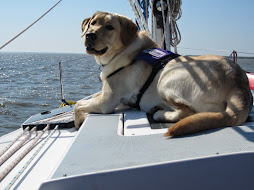
Onyx is now practicing loose leash walking every day. While she was in Gettysburg with her puppy raisers, Carol took her for a walk, but Onyx did not do very well with loose leash walking. She didn't want to listen to any of Carol's cues. Carol had to cut the walk short. This particular time, Onyx was not wearing her service dog-in-training harness. Often, the dogs learn that when their harness is on, it's time to work. When the harness is off, they can relax and have down time. When they work on loose leash walking, Carol plans to dress Onyx in her purple harness and see if that makes a difference. Like all skills, loose leash walking is one that requires practice.
This past week, Onyx had some new experiences. The pier behind Mark and Carol's house flooded, and when the water receded, Onyx went down to investigate. There was a large piece of wood floating by the pier. Onyx probably thought the wood was part of the pier because she stepped on it - and stepped off real quick when it moved!
Later, she found some chestnuts floating in the water, and she tried to get one. Carol says she looked like she was bobbing for apples. Onyx seemed to know what she was doing, though, because when her nose was underwater, she blew bubbles. She did eventually get a chestnut, and she carried it around with her.
Read more about Onyx's progress next week.



 Posts
Posts

