Showing posts with label service dog skills. Show all posts

Wednesday, March 2, 2016

Why Crate Time Is Important for Service Dogs in Training


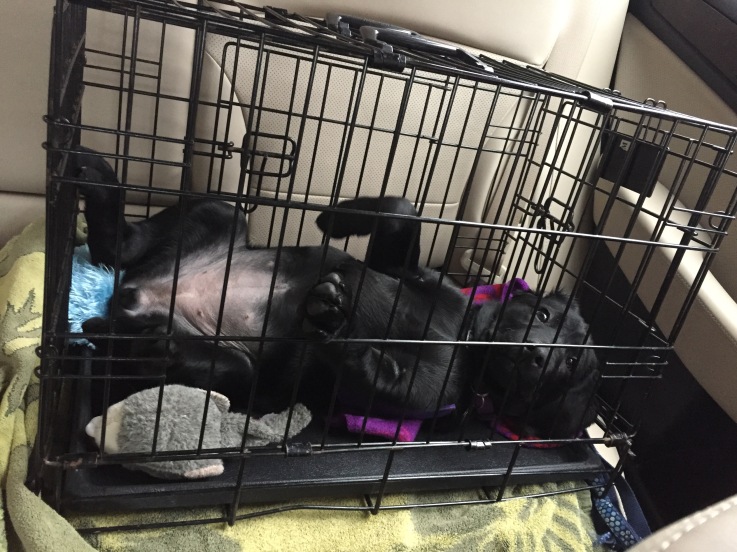
All of our service dogs in training are crate trained. Until they’re 16 weeks old, they ride in a crate in the car. At home or at the office, our puppies spend time in crates. They’ll spend time crated while they’re in advanced training, and they will most likely spend some time in a crate after they’re placed as working service dogs.

The goal is for the dog to go into their crate on cue (“kennel”) and then be able to spend at least 8 consecutive hours quietly relaxing inside with the door closed. The dog should be able to relax quietly in their crate overnight, during the day, when they’re alone, and when people are around.

There’s a misconception that crate time is a punishment, but that could not be farther from the truth. A dog’s crate is their safe spot. Think of the crate as the dog’s bedroom. It’s a place to relax, where they don’t need to think about working.

Why is crate training so important?

There are many reasons why crate training is important for service dogs.


Crates are a way for puppy raisers to manage their dog’s behavior.
If the raiser has errands to run and cannot take their puppy with them, crating the dog can prevent that dog from getting into mischief while they’re home alone. For example, crating the dog will prevent them from forming bad house manners, such as hopping on furniture or countersurfing. 

Our dogs never outgrow crate time. Crate training is actually part of a dog’s good house manners, and dogs that cannot spend time quietly in their crate may be discharged.

Dogs spend time in crates during advanced training.
When our dogs in training come to the kennel for advanced training, they will be spending time in a crate. We may have anywhere from 15-20 dogs in advanced training at one time. While the dogs spend time working with our trainers and going out in public with our volunteers, they don’t train for the entire day. They need time to relax, and one place where they do that is in the crate.

Crates give service dogs a place to relax.
We recommend that our partners get a crate for their dog. It gives the dog a place where they know they can relax stress-free. For facility dogs that are supporting many people or children, the crate becomes even more important. Working with an entire classroom of students is very challenging for a service dog. In fact, it takes a special temperament to be able to do this work because it can be very stressful. Having a crate—a safe spot—gives facility dogs a stress-free zone to relax, take a nap, or chew on a bone.

Crates are a place where service dogs can safely sleep.
It’s the partner’s choice whether their service dog is allowed on the bed. Not all of our partners want their service dog to sleep in bed with them. Depending on the person’s disability, it may not be possible for the service dog to sleep in bed. For example, a person may use certain medical equipment at night, or it could be that any movement by the dog on a bed causes the person pain. The crate becomes the perfect place for the dog to sleep, eliminating the possibility that the dog will help themselves to the bed during the night.


How to crate train your dog


To help your dog enjoy being in their crate, start by putting the crate in an area where your dog will still be able to see people. You don’t want your dog to be isolated from everyone when they’re in their crate. You can also include a soft blanket and a safe, favorite toy.

Introduce your dog to the crate simply by tossing a piece of dog food inside. Let your dog go inside to eat it, but leave the door open. If your dog chooses to stay inside the crate, great! Leave the door open and keep tossing kibble inside every few seconds. If your dog chooses to exit the crate during this exercise, that’s okay, too.

Once you’ve introduced the crate, feed your dog a meal inside it at least once a day. Soon, your dog will associate good things (food and mealtime!) with the crate.

When your dog is inside the crate, it’s really important NOT to let them out if they whine or bark. If you let them out every time they whine or bark, they’ll learn that making noise is the way to get out of the crate. Only let them out after they’ve been quiet for a little while. This part of crate training can be very challenging for puppy raisers because some dogs can be very determined barkers! But stay strong and wait them out. You, our trainers, and the dog’s future partner will all benefit.

Once your dog is comfortable being quiet in their crate, move the crate to different locations and add challenges! Your dog should be able to relax quietly and calmly in their crate when:
  • Other dogs are crated nearby
  • Other dogs are off leash around the crate
  • You're working with another dog (Team up with a friend if you don't have two dogs available.)
  • The crate is outside
  • Adults or children are playing or working nearby
  • The doorbell rings or someone knocks on the door
  • There's a thunderstorm


Wednesday, January 16, 2013

There Are Training Opportunities Everywhere

SSD Kiwi demonstrates her "leave it" skills at puppy class.


SSD Irwin walks over a grate - no problem!

SSD Irwin practices going up open airway stairs.

SSD Rizzo doesn't mind small spaces like this tunnel.

SSD Dublin checks out all the interesting surfaces at the park.

Thursday, November 15, 2012

Puppies Busy Learning


SSD Queen Mab’s eyes drooped from her puppy massage at the start of puppy class, but once it was time to work, she snapped to attention.

We always start our puppy classes with puppy massage. Puppy class can be very exciting for a dog because they get to see other dogs that they haven’t seen in a while. Puppy massage is a way to calm them down, resulting in a relaxed pup that can focus on the cues its puppy raiser gives it.  

In yesterday’s puppy class, we started preparing for the types of things that might appear on the end of semester evaluations. Three of the cues were “fix,” “visit,” and “back.”

“Fix” is useful when a dog gets tangled in the leash. On the cue “fix,” the dog will lift its paws until its legs aren’t tangled in the leash anymore.

“Visit” is an excellent way to bring the dog closer to you, and it’s one of the cues that all of our dogs need to know. On cue, the dog puts its chin in a person’s hand or on their lap and holds it there for an indefinitely amount of time.

Watch SSD Nook start to learn “visit.” Her puppy raiser clicks as soon as Nook’s chin hits her hand. When Nook experiments and tries jumping, her puppy raiser quickly moves her hand away.


Watch SSD Queen Mab practice “visit.” Notice that when Mab wiggles her head around, her puppy raiser pulls her hand back, waits for Mab to settle, and then presents her hand again. Also notice that by the end of the video, her puppy raiser is asking for a visit by placing her open palm on her lap. This is the first step to getting Mab to do “visit” by putting her head on her puppy raiser’s lap without the hand signal.


Next we practiced “back,” another cue that all of our dogs need to know. Our goal is to have the dog walk backwards in a straight line. To train this cue, we start with the dog in a chute so that the dog can only move backward. When the dog takes a step back, we click and treat. Gradually, we hold the click until the dog is taking more steps back. Once the dog is consistently walking backward, we move out of the chute to practice.

We don’t add the cue “back” until the dog can consistently take seven steps backward in the middle of a room. Why seven steps? That’s the approximate number of steps a dog will need to take to open a door using a pull strap. (The dog grabs the pull strap that’s attached to the door, pulls, and backs up.)

Watch SSD Beaker take a few steps back while he’s in a chute.


SSD Falstaff moves backward while his puppy raiser stands still at the front of the chute.


SSD Honeydew loves the cue “back.” Watch her enthusiasm as she trots backward for her puppy raiser.


We closed out the class with a game that we call “Puppy 911.” Our puppy raisers and dogs form two teams, each behind a bucket of water. Puppy raisers need to fill a cup with water and dump it in a bucket several feet away, all while their puppy walks on a loose leash. To add an extra challenge, puppy raisers had to hold the cup of water and the leash in the same hand.

The Puppy 911 game is great experience for the dog because they get to practice loose leash walking in an exciting situation. And just think: If a puppy raiser can hold the leash and carry a cup of water with spilling, then that dog’s future partner will be able to hold the leash and carry a cup of coffee from the cashier to their table in a coffee shop.

Monday, March 19, 2012

Discovering a Service Dog’s Personality

Life happens quickly, and since service dogs accompany their partners almost everywhere, they need to be able to adjust to whatever comes their way. Because of that, service dogs need to have a certain personality to successfully assist their partners.

SSD Fred, SSD Lewey and SSD Rummy are at the kennel for their 12-month evaluation. We evaluate all of our dogs when they’re 8 weeks old, 6 months old and 12 months old. We want to make sure that the dogs are well-suited to become service dogs. A dog that gets very stressed being in public would not be able to provide its partner with assistance, nor would it be fair to the dog to continually take it into very stressful situations. We like to make sure that the dogs will be happy and successful working as service dogs.

Lewey, Fred and Rummy are taking a temperament test, which lets us see their personality. For this evaluation, we’re not as concerned with the specific skills they’ve learned, so there’s no need for puppy raisers to try to cram in multiple training sessions to make sure their dog does a perfect “heel.” Instead, we’re looking at how the dogs handle different situations, especially situations that may be stressful.

The 12-month evaluation helps us determine what direction a dog’s career may take. Some dogs may be spayed or neutered so they can continue in their training to become working service dogs. If we think a dog might be a good fit for our breeding program, we will keep the dog intact until they come into advanced training, where we will evaluate them as a potential breeding dog. Dogs may also be moved into the companion dog program, where they will become a pet that is trained in specific tasks to assist a child or other family member. If we find that a dog is not going to be happy and successful doing service dog work, we may discharge them from the SSD program. Discharged dogs sometimes find new careers. SSD Hawk left our program to join the Bureau of Alcohol, Tobacco, Firearms and Explosives (ATF), and he now works as an explosive detection dog in Jordan. SSD Sunshine also joined the ATF, and we have had several dogs become explosive detection dogs with the UN.

After the 12-month evaluation, we give our puppy raisers a copy of the information we collected in the evaluation, as well as some ideas for how they can continue to work with their dog to help them succeed. We love to see our dogs succeed, whether they continue in our program to become service dogs, join another organization to find a new career that suits their skills, or become beloved pets.

Friday, January 7, 2011

SSD Nubble's Travels

Nubble joined us in Harrisburg for puppy class on Wednesday! We were very happy to have him in class. It gave him the chance to be around other dogs that he isn't familiar with. If you'd like to read about our puppy class and see some videos of Nubble, check out Fun and Games at Puppy Class.

In the Northeast group's puppy classes, they're learning musical canine freestyle or dancing with dogs! Nubble loves it! He loves to learn new things. Right now, he, Donna and Lindsey are in the very beginning stages of learning freestyle. Donna and Nubble have been watching videos of musical freestyle. At first, Nubble just barked at the dogs on the screen, so Donna turned it into a training opportunity. Now he just rests his head on Donna's lap and watches the screen.

They also practiced "stand stay," where the dog stays in a standing position while you walk away. This can be very difficult for dogs because it's very easy for them to simply follow you since they're already in a standing position. Nubble, however, was a pro. Donna and Lindsey realized that they had actually been working on this behavior for a while now because they always make him wait at doorways.

As well, they worked on walking around an object. For example, if the dog gets his leash tangled or walks around a street sign on one side while you walk on the other side, he'll be able to untangle himself.

The week after Christmas, his puppy raisers took Nubble back to the mall. They practiced steps and just walked around. We always give our dogs the opportunity to potty before we enter a building, but that doesn't mean they will always use that opportunity. Nubble didn't go before he and Donna went inside the mall, so Donna watched his body language closely, and as soon as he started acting like he needed to go out, they headed straight for the nearest exit. Nicely done! Nubble did his business on the sidewalk, which is also a good thing. Service dogs need to be able to potty on all surfaces. When they're placed with a partner, they may not live near a grassy area, so they'll need to be comfortable with whatever surface is available to them. And even if a service dog does live in an area where he has a yard, he and his partner may visit places that do not have grass and bushes available. For example, if they fly, the dog will need to be able to go on concrete before getting on the plane. Once on the plane, it could be hours before the dog has another opportunity. Great job, Nubble.

A few other puppy raisers recommended that Donna and Lindsey take Nubble to the Canine Spa in Dillsburg, PA. Nubble had a blast! Donna was a little concerned about taking Nubble into a strange place where there are lots of strange dogs off leash, but Nubble took it all in stride. A three-year-old Saint Bernard dashed right over to him, and the two dogs romped and played. Nubble also had fun with a young black lab and an older yellow lab. He was very sweet with the older lab.


Then SSD Cabo and SSD Pearl came in! All of the dogs got along well until Nubble and Cabo wanted to same toy. However, once they got the dogs calmed down again, they gave Nubble and Cabo some time to get to know each other, and soon they were able to co-exist. Nubble tended to avoid Cabo's toys, and Donna and Crystal always made sure to toss two toys if both dogs were in the water.

At one point, Lindsey tossed a toy more that halfway across the pool. Nubble swam to get it, but then he couldn't figure out what to grab, so he grabbed the foam pool noodle that covers the metal rack for the dock at the other end of the pool. He then swam all the way back to Lindsey with it!

They used the Canine Spa to practice recalls, and Nubble did very well considering all the distractions. He also showed good self control by sitting and waiting until a toy was thrown for him. It was a wonderful trip, and needless to say, Nubble slept very well that night!


On Sunday, Donna and Lindsey took Nubble to Cracker Barrel. Six months ago, Nubble would have had a very difficult time, but now, he did great! Donna called ahead to let Cracker Barrel know that she would be bringing a service dog in training. (Although this isn't necessary for places that cater to the public, it sometimes helps.) When Donna put their names on the list, she said two people and a service dog, and when their table was ready, the hostess announced, "Party of three!" Nubble did great walking through the busy dining room. Once they were settled at the table, he just rested beneath the table and did the occasional visit on Donna's lap.

At one point, the waitress came over to pull down the blind at their window. She had to reach over Nubble, but he didn't even move! He just looked at her. Great job, Nubble! When their food arrived, it became a little more challenging for Nubble. He smelled the bacon and that's all he could think about. It took a little while for Donna and Lindsey to help him realize that he was not going to get any bacon, but he eventually did settle back down under the table. When they left the restaurant, he strolled through the dining room on a nice loose leash, and while they were paying, he waited patiently without even trying to sniff any of the tempting items at the counter! What a successful outing!

We're looking forward to more stories of Nubble's success!

Nubble loves belly rubs! Look at that smile!

Thursday, January 6, 2011

Fun and Games at Puppy Class

It's a new semester of puppy class, and the dogs are learning some new behaviors.

The puppies in training are going to start working the cue "paw," where the dog calmly places his paw in his handler's hand. On the surface, this seems like it's just a cute trick, having the dog shake hands. However, it can be very important for nail clipping. All of our dogs must be comfortable having their nails cut, and "paw" can be used to have the dog give his handler his paw so his nails can be cut.

The puppies are also learning to use a target stick. A target stick is a piece of duct tape at the end of a wooden dowel or some sort of stick. Goal is to have the dog calmly touch his nose to the duct tape. This teaches the dog to target duct tape with his nose, and we can then use this skill to teach more advance behaviors, such as pushing a button to open an automatic door or touching a person's leg to alert them to a sound.

Watch SSD Rio touch the target stick with her nose.


Loose leash walking is one of the most important skills a service dog can have. The dog must learn self control to walk nicely beside his handler with the leash in a loose J shape. There are many methods of teaching loose leash walking, and the method you use depends on the situation. In the new method we taught last night, handlers walk backwards while the dog walks forward on a loose leash. Handlers click and treat the dog for walking on a loose leash. This method is often successful because the dogs are not used to pulling when they're walking toward you, so they should be walking on a loose leash.

Watch SSD Sienna, SSD Zappa and SSD Nubble, who joined us from the Northeast, demonstrate the new method of training loose leash walking.


Although loose leash walking is an extremely important skill for service dogs, it's not the most exciting skill to teach. To make it more fun, we played musical hoops. Musical hoops is a game similar to musical chairs, only we substitute hula hoops for chairs. The hoops are arranged in a circle and while the music is playing, the dogs must walk around the circle on a loose leash. When the music stops, each dog must sit with at least two paws in a hoop. Of course, there is one less hoop than there are dogs. The dog without a hoop was eliminated from the game, we removed one hoop, and the dogs continued walking on a loose leash. We continued playing until there was only one dog left. All of the other dogs practiced very nice down-stays.

Watch SSD Jagger, SSD Nubble, SSD Taz, SSD Topaz and SSD Yukon play musical hoops.


Wednesday, January 5, 2011

National Train Your Dog Month

When the weather turns cold, and you and your dog are spending less time outside together, it's the perfect time to teach your dog new tricks and behaviors. The Association of Pet Dog Trainers (APDT) has selected January as National Train Your Dog Month.

Training your dog is a wonderful way to build the bond between you. We use clicker training to train our service dogs, and it's fun for us and the dogs. Our dogs love when the clickers and treat pouches appear.

Clicker training uses positive reinforcement. The click of the clicker marks a very specific behavior, and the dog immediately gets reinforced for it, usually with a piece of food. The dog will then repeat that behavior in the hopes of receiving another click and treat. Using this method, it's very easy to quickly shape a behavior that otherwise may take months.

Once a week in January, we will be posting a new training exercise for you and your dog to try. Although today's training tip is appearing on Wednesday, future tips will appear on Tuesday.

Dog Meal Time: Teaching Self Control

Most of the dogs we train are labs, and as you may know, labs are motivated by food. They love to eat almost anything they can get. At meal times, they have a tendency to dive head first into their food bowl, only coming up for air once the bowl has been licked clean.

One of the very first things we start teaching our puppies is self control, which may be the most important skill a service dog can have. We start teaching self control with the food bowl.

At meal times, all of our dogs must sit and stay (uncued) until the full food bowl is placed on the ground. They must then continue to sit and make eye contact with their handler until given the cue "okay, " which releases them to go eat.

Watch the video of SSD Thunder demonstrating self control around the food bowl. If you watch closely, you'll see his eyes flick upward toward his handler right before she gives him the "okay."


How to Train It


1. After you put food in your dog's bowl, stand and hold the food bowl in front of you. Without using any words, wait for your dog to sit. This may take a while, but your dog will sit eventually.

2. Slowly lower the food bowl to the ground, but be ready to pick it up again if your dog moves toward it. If your dog moves, simply pick up and hold the food bowl until he's sitting again.

3. Once the food bowl is on the ground and as soon as your dog pauses momentarily, say "okay" and let your dog eat.

4. Gradually increase the amount of time that your dog waits before you give him the "okay" to eat. Eventually wait for your dog to make eye contact before saying "okay."

If your dog manages to get to his food bowl before you give him the okay, do not punish him. Simply try again at the next meal and make sure you're faster at picking up the food bowl when he moves.

Be patient and don't try to push your dog too fast. This can be difficult for him, especially if he's used to diving right into his food bowl. It will probably become easier after about five days. If you're consistent and keep at it, you'll soon have a dog that will sit and stare at you while his food sits right in front of him.

Happy training! Let us know how your dog is doing in the comments.

Wednesday, October 27, 2010

Our Trip to Zoo America


What could be better than going to the zoo on a beautiful Saturday afternoon? Going to the zoo with a service dog-in-training!

Fifteen service dogs-in-training went to Zoo America for a puppy class outing. Throughout the year, we take the dogs on several outings so the dogs get experience working in public. Although our puppy raisers frequently take their dogs out in public, these special planned outings are also helpful for the puppy raisers because it gives them a chance to work in public while our trainers are right there to give support and answer any questions they might have.

Our Zoo America is always a fun outing, and it's a wonderful opportunity for the dogs and puppy raisers to practice their skills. With so many distractions, it's a challenge for the dogs to stay focused. Our puppy raisers were ready with power treats (treats like chicken, cheese, or other yummy things that the dog only gets in challenging situations), which really helped the dogs stay focused on their handlers.

Because the dogs were around so many different animals, it was a great opportunity for puppy raisers to practice reading their dog's body language. They needed to watch their dog to make sure that they weren't becoming too excited or stressed from the zoo animals. For example, when we stopped at the wolves' area, we paid special attention to the dogs, and if they started to get too excited, or started barking, the puppy raiser removed them from the area. SSD Topaz approaches the wolves in this video. You can tell from his body language that he is aware of the wolves, which are about twenty feet in front of him. However, he is still able to focus on this puppy raiser - see how he turns and looks at her? As soon as he gives her his attention, she clicks and treats.


In addition to watching the dogs' body language, we also paid close attention to the zoo animals' behavior because we did not want to upset them or cause too much stress. We had to be especially watchful in the wolves' area, because as soon as the alpha wolf smelled the dogs, he started pacing. If he and the females of the pack started to get stressed, we removed the dogs, even if the dogs were just sitting there quietly observing. In this video of the wolves, you can see the male wolf pacing back and forth. You can tell that he's very aware of the dogs, although at this point he is not overly stressed about it.


All of the dogs were very interested in the wolves. Can you guess what other animal almost all of the dogs were extremely interested in? The fish! At the bears' area, you can watch the fish through the glass, and almost every dog that saw them was fascinated by them, especially since they have probably never seen a fish before. SSD Topaz wasn't entirely sure what to make of the fish, but he did a great job and didn't bark at them.


SSD Star and Falcon also though the fish were fascinating, but they are not so distracted that they can't pay attention to their handlers. Watch how Star's puppy raiser works with her to get her to walk nicely on a loose leash. Once they get to the fish, Star does an "up."


SSD Hendrix, on the other hand, wasn't interested in the fish at all.


SSD Journey, one of our dogs in advance training, spent some time near the bear's habitat. She seemed much more interested in her puppy raiser than in the bear, though. Even when her puppy raiser pointed to the bear, Journey just looked and then turned right back to her puppy raiser. Wonderful!


One of the most important skills a service dog can have is the ability to walk on a loose leash. Throughout our entire zoo outing, we continually worked on loose leash walking, which can be very challenging for dogs, especially when there are such great smells around. Loose leash walking is all about self control for the dogs. They need to ignore distractions and stay right next to their handler. In this video, SSD Grace works on loose leash walking. Watch what Grace's handler does when Grace starts to pull ahead. He stops, backs up until Grace comes back to him and turns around. Then when she starts loose leash walking again, he clicks and treats.


Why is loose leash walking so important? Imagine a balance dog and their partner walking along the sidewalk to get to the car. As they get close to a tree, the dog smells something wonderful. He lunges to get to it. His partner is thrown off balance and falls.

Now picture a service dog for a child with autism. While the parent is holding the leash, the child is holding a special strap attached to the dog's harness. If that dog pulls on the leash, the child is going to be pulled as well.

Loose leash walking is important, and the dogs need to do it all the time, in every environment. The zoo was a great place to practice!

Thank you to Zoo America!

We try to plan several outings for the dogs-in-training, and we're always open to suggestions. We look for places that have lots of sights, sounds and smells. For example, we've done a Ghosts of Gettysburg tour, Chocolate World, a memorial day parade, a bus ride, and National Night Out. If you have any ideas for other places in Central PA where we could take the dogs-in-training, please let us know in the comments. Thank you!

Wednesday, June 16, 2010

Team Training at the Whitaker Center

Floating beach balls, earthquakes and hurricane force winds, giant sneezing clowns - our new service dog teams in training encountered all of these things yesterday. Where were they? The Whitaker Center for Science and the Arts!

The Whitaker Center is a wonderful outing for the teams in training because not only do the teams get to practice in a challenging environment, but it's a lot of fun, too!

Each team paired up with an experienced trainer or volunteer and worked their way through all three levels of the Whitaker Center's Science Center. The Science Center is full of things that could potentially be very distracting or even scary for the dogs. For example, as soon as you walk into the Science Center from the information desk, there's a display where you can push a button and a stream of air will shoot up to make a beach ball float in the air. The dogs did very well at this display. They were curious about the floating ball but not so curious that they didn't respond to their partners.

Other areas gave the teams opportunities to practice other skills. SSD Snow practiced pushing buttons, Aladdin did under at the Legos table, Bella practiced take it to pick up a dropped Lego block, Sonora did up on the slide and Aurora showed off leave it at the wiffle balls spinning in a giant funnel.

Watch a video of the teams at the Whitaker Center.

Thank you to the Whitaker Center for donating the tickets for our service dog teams!

Tuesday, March 16, 2010

Aladdin's Weekend Outings

SSD Aladdin has returned to advanced training after being out on medical leave. (He and two of his brothers, SSD Phillip and Caspian, had had surgery to correct Cauda Equina Syndrome.) He will spend his weekdays at the SSD kennel learning service dog skills, and he may eventually be placed with a partner and become a working service dogs. On weekends, though, he still goes home with his puppy raiser.

Because of PawsAbilities weekend, Aladdin and the other dogs had a short week at the kennel. They returned home to their puppy raisers for an extended weekend while we prepared for the big event.

For the past month or so, Aladdin's puppy raisers have been getting him ready to return to advanced training. Cindy, his puppy raiser, has been taking him on several outings to practice loose leash walking and behaviors in public.

Their first trip was to the grocery store. Because of his surgery, it had been a little while since Aladdin went out in public, and this first trip was very short. As soon as they walked through the door, he grew very stressed. Cindy took him to a quiet corner of the store and simply worked on his attention to her, an exercise to calm him and help him focus. After a few minutes, though, she realized he was still stressed, so they went home.

One week later, Cindy took him out in public again. This time, they went to PetSmart, which is a very challenging outing for him. But after a little while, he did great! When they first got to the store, Aladdin didn't want to pay attention to Cindy at all. He loves to play with other dogs, so he was very distracted. Cindy sat outside on the pavement with him, and then they slowly worked their way through the door. They avoided the treat aisle because Aladdin tries to pick out all the treats he thinks he should have. He showed no signs of stress until they had been working inside for 10 minutes. Then Cindy moved him to a quiet corner and working on attention to calm and focus him. Soon, he was doing very well!

For his next outing, they went to the movie theater in the mall! Aladdin did great in the mall! In order to get to the theater, they had to ride a glass elevator. At first, he wasn't too keen on the elevator, but Cindy put him in a down and gave him lots of treats, which helped a lot. Once inside the theater, he settled right down and made himself comfortable. About an hour into the movie, he began to get restless, so Cindy took him out for a break. When they returned to the movie, he went right back to sleep. In the movie, there was a loud gun shot, which made Cindy and her daughter jump, but Aladdin kept right on sleeping! Wonderful!

For the next several months, Aladdin will be in advanced training. We'll post more about his weekend outings with his puppy raisers in the coming weeks.

Monday, February 22, 2010

Chocolate World

Our dogs-in-training visited Chocolate World in Hershey, PA on Saturday. The visit was one of our puppy outings. We hold several outings throughout the year that are designed to give the dogs experience in different situations.

The visit to Chocolate World was certainly a test of the dogs' skills. The dogs and their puppy raisers went on the Chocolate World ride, which tells the story of how Hershey makes its chocolate products. To get on the ride, the dogs had to walk down a set of stairs onto a rotating floor. From there, they had to climb into open cars, which take you through the ride.

Some of the dogs had no problem getting on the cars. They didn't even hesitate at the rotating floor or the cars. Other dogs wanted nothing to do with the cars. One of our demo/interview/therapy dogs, SSD Rossi, was a calming influence on some of the dogs. By calmly demonstrating how to get on the ride, she showed some of the dogs that the cars weren't something to be afraid of.

The cars swiveled slowly from side to side as the narrator discussed different parts of the story. Within the ride, the dogs encountered things like singing cows, active sample factory machinery, and of course, the smell of chocolate. At the end of the ride, dogs had to exit the cars and walk off the rotating floor and go back up the steps. At the top of the stairs, the dogs had to go through a turn stile.

And then came one of the big tests. At the end of the Chocolate World ride, Hershey always gives away free samples of its candy, usually a new product. Right now, the new product is Pieces - candies like York Peppermint Patties, Almond Joy and Special Dark Chocolate in a candy-coated shell, similar to Reese's Pieces. That means that there were pieces of chocolate candy on the floor. The dogs got lots of leave it practice!

Here are some videos from the dogs' trip to Chocolate World:

SSD Lavender climbs off the car of the Chocolate World ride.


SSD Aspen practices loose leash walking after getting off the ride.


SSD Rossi demonstrates a service dog skill for visitors - unzipping a jacket.

Monday, February 1, 2010

Practicing Skills at the Broad Street Market

Several of our dogs in advanced training had a real challenge on Thursday. They had to ignore the smells of fresh meat, fruit, vegetables and desserts as they practiced their skills.

We went to the Broad Street Market in Harrisburg, PA - a farmers' market with a smorgasbord of smells to challenge the dogs as they practiced their skills. When the dogs are in advanced training, we go to different public places to practice. Because the dogs will be going everywhere with their partner, they need to be able to give behaviors no matter what environment they're in. With the help of a wonderful group of volunteers, we take the dogs out in public once or twice a week. The Broad Street Market was one of our most challenging outings for the dogs, but they did very well!

We worked on skills such as loose leash walking, go on through at doors, leave it, greeting people, retrieves and basic obedience. Some of the dogs worked on their skills around wheelchairs, such as opening doors and pulling the wheelchair.

Here are a few videos from Thursday's outing:

In this video, SSD Natalie practices recalls. It's particularly challenging to give this behavior in a strange environment where there are so many smells to investigate and new people to meet. Natalie does a great job ignoring all the distractions.

SSD Gnat opens a door for a person who uses a wheelchair. Doors, especially heavy doors, can be challenging for a person who uses a wheelchair to open by themselves. A service dog can be trained to open the door and hold it open. The new environment made this skill a little more challenging for Gnat, but that's what practice is for. He soon focused and opened the door like a champ.

Gnat and SSD Sonora are learning how to pull a manual wheelchair. Look for a blog post next week about how these two dogs are learning this skill.

Our public outing to the Broad Street Market was a great success! Thank you to the Broad Street Market for being so understanding about service dogs!