Tuesday, March 15, 2016
I #WalkforSSD Because Dogs Make People Smile
Guest post by Maddie Levy. Maddie and her family have been volunteer puppy raisers and sitters for the past four years.
For four years, my family and I have opened our home to Susquehanna Service Dogs' puppies in training. During that time, we have raised, trained, and puppy sat future service dogs. Currently, we are raising SSD Truffle, whose mother, SSD Splash, we co-raised with another volunteer.
While raising Splash, our goal was obviously for her to become a working service dog. However, SSD had plans for her as a breeder, and she recently had her first litter, the Sweet Treats. Bringing Splash through the program and seeing her have her litter has brought us nothing but joy and love. The moment we took her in, we were impacted by her gentle and affectionate personality.
Splash's effect on the people around her is well illustrated by her actions at a doctor's appointment we had brought her to about a year ago. As we were checking out, Splash was sitting next to me. I felt a tug on the leash. When I looked behind me, I saw a baby, maybe a year old, hugging Splash, who was leaning into her, resting her head on the girl's shoulder.
The reason I walk for SSD is because I love to watch my dogs make people smile. Seeing the puppies make a difference in my life, my family's life, and even brightening the days of everyone they meet confirms their impact on their future partners, who in a time of need receive the companionship and aid of truly amazing and talented dogs.
Join Maddie and Susquehanna Service Dogs for the Highmark Walk for a Healthy Community. SSD is one of 47 organizations participating in the Highmark Walk, and because Highmark generously underwrites the cost of the Walk, 100% of the funds you raise come directly to SSD. Sign up as a walker or virtual walker and #WalkforSSD!
Event Details
When
Saturday, May 21, 2016
Where
Harrisburg Area Community College
1 HACC Drive
Harrisburg, PA 17110
Registration
Sign up for the Walk
Wednesday, March 2, 2016
Why Crate Time Is Important for Service Dogs in Training
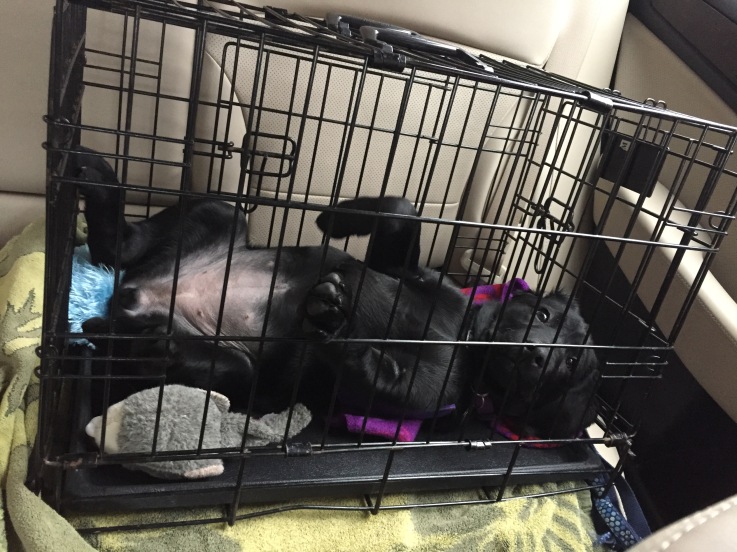
All of our service dogs in training are crate trained. Until
they’re 16 weeks old, they ride in a crate in the car. At home or at the
office, our puppies spend time in crates. They’ll spend time crated while
they’re in advanced training, and they will most likely spend some time in a
crate after they’re placed as working service dogs.
The goal is for the dog to go into their crate on cue
(“kennel”) and then be able to spend at least 8 consecutive hours quietly
relaxing inside with the door closed. The dog should be able to relax quietly
in their crate overnight, during the day, when they’re alone, and when people
are around.
There’s a misconception that crate time is a punishment, but
that could not be farther from the truth. A dog’s crate is their safe spot.
Think of the crate as the dog’s bedroom. It’s a place to relax, where they
don’t need to think about working.
Why is crate training
so important?
There are many reasons why crate training is important for
service dogs.
Crates are a way for
puppy raisers to manage their dog’s behavior.
If the raiser has errands to run and cannot take their puppy
with them, crating the dog can prevent that dog from getting into mischief
while they’re home alone. For example, crating the dog will prevent them from
forming bad house manners, such as hopping on furniture or countersurfing.
Our dogs never outgrow crate time. Crate training is
actually part of a dog’s good house manners, and dogs that cannot spend time
quietly in their crate may be discharged.
Dogs spend time in
crates during advanced training.
When our dogs in training come to the kennel for advanced
training, they will be spending time in a crate. We may have anywhere from
15-20 dogs in advanced training at one time. While the dogs spend time working
with our trainers and going out in public with our volunteers, they don’t train
for the entire day. They need time to relax, and one place where they do that
is in the crate.
Crates give service
dogs a place to relax.
We recommend that our partners get a crate for their dog. It
gives the dog a place where they know they can relax stress-free. For facility
dogs that are supporting many people or children, the crate becomes even more
important. Working with an entire classroom of students is very challenging for
a service dog. In fact, it takes a special temperament to be able to do this
work because it can be very stressful. Having a crate—a safe spot—gives
facility dogs a stress-free zone to relax, take a nap, or chew on a bone.
Crates are a place
where service dogs can safely sleep.
It’s the partner’s choice whether their service dog is
allowed on the bed. Not all of our partners want their service dog to sleep in
bed with them. Depending on the person’s disability, it may not be possible for
the service dog to sleep in bed. For example, a person may use certain medical
equipment at night, or it could be that any movement by the dog on a bed causes
the person pain. The crate becomes the perfect place for the dog to sleep,
eliminating the possibility that the dog will help themselves to the bed during
the night.
How to crate train
your dog
To help your dog enjoy being in their crate, start by
putting the crate in an area where your dog will still be able to see people.
You don’t want your dog to be isolated from everyone when they’re in their
crate. You can also include a soft blanket and a safe, favorite toy.
Introduce your dog to the crate simply by tossing a piece of
dog food inside. Let your dog go inside to eat it, but leave the door open. If your
dog chooses to stay inside the crate, great! Leave the door open and keep
tossing kibble inside every few seconds. If your dog chooses to exit the crate
during this exercise, that’s okay, too.
Once you’ve introduced the crate, feed your dog a meal
inside it at least once a day. Soon, your dog will associate good things (food
and mealtime!) with the crate.
When your dog is inside the crate, it’s really important NOT
to let them out if they whine or bark. If you let them out every time they whine
or bark, they’ll learn that making noise is the way to get out of the crate.
Only let them out after they’ve been quiet for a little while. This part of
crate training can be very challenging for puppy raisers because some dogs can
be very determined barkers! But stay strong and wait them out. You, our
trainers, and the dog’s future partner will all benefit.
Once your dog is comfortable being quiet in their crate,
move the crate to different locations and add challenges! Your dog should be
able to relax quietly and calmly in their crate when:
- Other dogs are crated nearby
- Other dogs are off leash around the crate
- You're working with another dog (Team up with a friend if you don't have two dogs available.)
- The crate is outside
- Adults or children are playing or working nearby
- The doorbell rings or someone knocks on the door
- There's a thunderstorm
Thursday, February 25, 2016
I #WalkforSSD because puppies-in-training change lives every day
Guest blog post by Deb Tack. She and her family are first-time puppy raisers for Susquehanna Service Dogs. They're currently raising SSD Motzi from the Cheese Litter.
For years, our kids asked for another dog--a puppy, of course. Consistently and more times than I can count, the answer was "no." But I wouldn't be writing this if there weren't an "Until..."
Until I read of a brave, young local veteran who suffered from post-traumatic stress disorder and trained his own puppy to alleviate his pain from the horrors of war. His story, as told by his mother, inspired me to learn more about raising a service dog through Susquehanna Service Dogs. Yes, our family could have a puppy, as long as we could train and love her and then let her go.
Since August, we have been raising SSD Motzi. Each day, I have the privilege of watching her touch the lives of others while changing ours as well. The stories are countless: watching Motzi and her fellow puppies in training bring laughter to high school students grieving the loss of their friends; meeting a first grader who smiled, enthusiastically asked to pet Motzi, and told me all about the "super awesome" service dogs at his school and how he "loves loves loves" them; sitting by the wheelchair of an elderly woman who, with damp eyes, tenderly pet Motzi and told us over and over the names of her dogs and how much she missed them; and meeting the mall employee who shared a beautiful story of how a Susquehanna Service Dog helped her sister regain her long-lost independence.
At home, Motzi gets to be a regular puppy. You can't help but smile when she plops herself on your lap with a huge groan and a sigh after a long day. She makes us laugh when she sees something new and tilts her head to ask, "What's that?" And she knows just when to cuddle up and let you pet your worries away.
As any puppy raiser will surely tell you, the question asked most often is "How will you give her up?" My reply, "I think about that every day, and it will be sad; but I've always known she was leaving, and I can't wait to see what she becomes."
What Motzi's future holds is yet to unfold. But there is one thing I know for sure. No matter where her paws take her, she has already changed at least one life. (And don't tell my husband, but I'm pretty sure Motzi isn't the only SSD puppy who will be part of our family.)
Event Details
When
Saturday, May 21
On-site registration starts at 7:45 a.m.
5K Walk begins at 9 a.m.
One Mile Fun Walk begins at 9:15 a.m.
Where
Harrisburg Area Community College
1 HACC Drive
Harrisburg, PA 17110
Registration
Sign up for the Walk
Monday, February 22, 2016
Not All Dogs Become Service Dogs
Not all the dogs in our program become service dogs.
Although every dog starts on the same path, only 50-60% of them become working
service dogs. Being a service dog is challenging. A dog must be able to “turn
on” and perform tasks, but then “turn off” and relax when they’re not needed. They
must be able to handle the stress of working in public. And most of all, they
must enjoy service dog work.
What happens to our
dogs who don’t become service dogs?
Sometimes our dogs show us that service dog work is not for
them. This can happen at any point in a dog’s training. What happens to the
dogs who don’t make it through our program?
Just because a dog doesn’t become a service dog doesn’t mean
the dog failed. And it certainly doesn’t mean that the puppy raiser failed. Quite
the opposite, actually. Many of the dogs that “don’t make it” simply change
careers and continue changing lives. That was the case for Autumn, Delilah,
Diesel, and Dory. These four dogs were recently accepted into the CIA’s
training program. And just this past December, former SSD dogs Aunt Nancy and
Thor graduated as CIA dogs! We’ve also placed dogs with the United Nations; the
Bureau of Alcohol, Tobacco, Firearms, and Explosives (ATF); and the state
police.
Other dogs may become therapy dogs and work in schools. We have
placed several dogs with Hill Top Academy, and the difference they have made in
students’ lives is incredible. This video from Hill Top Academy says it better
than we ever could:
(The part about Hill Top Academy starts around 0:35.)
The dogs at Hill Top Academy are changing students’ lives,
and in at least one instance, saved a student’s life. These dogs are doing the
work that best suits them and it’s making a difference.
Even if one of our dogs simply becomes a family pet, that
doesn’t mean the dog or raiser failed. It just means that the dog found the right
path for them, and their raiser helped them get there.
While each dog’s journey may start out the same, where they
end up varies, and it’s thanks to our puppy raisers that these dogs grow up to
change lives.
Tuesday, February 2, 2016
The Importance of a Good "Leave It"
The snow from the massive snow storm is starting to melt, but it can still be slippery out there. Floors and stairs inside can also become slick from snow that gets tracked inside on your shoes. While you’re out with your puppy in training during this time of year, one cue can mean the difference between staying on your feet and falling to the ground.
That cue is “leave it.”
SSD Elwood’s puppy raiser, Kelly Slabonik, knows the value
of a good “leave it.” As she and Elwood were walking down the stairs at work,
clicking and treating, one of Elwood’s treats fell out of his mouth and rolled
down the stairs. Kelly immediately said, “Leave it.”
Instead of lunging down the stairs and possibly taking Kelly
down with him, Elwood continued to walk calmly by her side. When they reached
the step with the treat, he waiting while Kelly picked it up.
No one fell down the stairs. No one got hurt.
And Elwood got a jackpot of treats to reinforce his
excellent behavior!
All of our puppies in training start learning “leave it”
soon after they join their puppy raisers. It’s one of the more difficult
behaviors for a dog to learn and needs to be reinforced constantly.
We start training “leave it” by holding a piece of dog food
in a closed hand in front of the puppy. We click and treat when the puppy
ignores the closed hand and makes eye contact with their raiser. Once the puppy
is consistently doing this behavior, we make it harder by holding the food in an
open hand, again clicking and treating when the puppy ignores the food.
We continue to make the behavior harder by putting the food
in different places, such as on the floor, on a coffee table, or on a chair. We
use different types of food and objects. The dogs practice walking past food on
the floor, table, etc., both on and off leash. And then we work on ignoring
food that falls to the ground in front of them.
We also train our dogs not to lunge after treats that fall
out of their mouth. Dropped treats are lost treats. This is especially
important for when the dog is working with their partner. We don’t want the dog
to injure their partner because they were chasing after a treat.
Do you have a “leave it” story about your service dog or dog
in training? Feel free to share it in the comments!
Monday, February 1, 2016
Sign Up for the Highmark Walk for a Healthy Community!
Susquehanna Service Dogs is participating in the Highmark
Walk for a Healthy Community again! Last year, you helped us raise over
$30,000!
This year, we’re raising the bar and setting a goal of
$32,000. We know that with your help, we’ll reach it!
Thanks to Highmark Blue Shield, which underwrites the entire cost of the Walk, 100% of the money you raise comes to SSD!
Registration for the Walk starts today. There are three ways
you can participate:
- Sign up for the Walk, raise money, and walk with us on May 21.
- Sign up as a virtual walker and raise money. This is a great way to participate if you can’t attend the actual Walk on May 21.
- Make a donation.
We hope you’ll join us this year and #WalkforSSD!
Event Details
When
Saturday, May 21
On-site registration begins at 7:45 a.m.
5K Walk begins at 9 a.m.
One-Mile Fun Walk begins at 9:15 a.m.
Where
Harrisburg Area Community College
1 HACC Drive
Harrisburg, PA 17110
Registration
Thursday, January 21, 2016
Service Puppies on the Moon
3…2…1…Blast off!
The seven puppies in Susquehanna Service Dogs’ Astronaut Litter have launched their journey to becoming service dogs! SSD Heide Piper (Heide), SSD Wendy Lawrence (Wendy), SSD Suni Williams (Suni), SSD John Glenn (Glenn), SSD Alan Shepard (Shepard), SSD James Lovell (Lovell), and SSD Neil Armstrong (Armstrong) are with their puppy raisers.
Each small step they take brings them closer to becoming
service dogs, and they couldn’t reach their destination without their puppy
raisers. For 15-18 months, raisers teach their puppy good house manners, proper
behavior in public, and 25 different cues. Our raisers give the dogs the solid
foundation they need to become working dogs.
Become a puppy raiser today and help a puppy’s small steps
become a giant leap for someone’s independence!
Labels:
Armstrong,
Astronaut Litter,
Glenn,
Heide,
Lovell,
puppy raisers,
Shepard,
Suni,
video,
Wendy
Subscribe to:
Posts (Atom)